
Who Can Manufacture Complex Aluminum CNC Parts in China?
When sourcing complex aluminum CNC parts, many buyers quickly discover that not every machining supplier can deliver the same level of capability.
On paper, hundreds of factories may claim to offer CNC machining services. However, when a project involves deep pockets, thin ribs, tight tolerances, multi-sided machining, or aerospace-grade aluminum such as 7075-T6, the number of qualified suppliers becomes much smaller.
For engineers and procurement teams, selecting the right supplier is not simply about finding the lowest price. It is about finding a manufacturing partner capable of consistently producing complex components with predictable quality, reasonable lead times, and reliable technical support.
In this article, we will discuss what makes an aluminum CNC part "complex", what manufacturing capabilities buyers should evaluate, and how to identify a supplier that can successfully deliver these challenging projects.

What Makes an Aluminum CNC Part Complex?
Not every aluminum component requires advanced machining capabilities.
A simple mounting plate with a few drilled holes can be produced by almost any CNC workshop. However, many industries—including aerospace, medical devices, robotics, automation equipment, and semiconductor manufacturing—often require components with significantly higher manufacturing complexity.
Typical examples include:
Deep cavities with high depth-to-width ratios
Thin structural ribs
Multi-sided machining features
Tight positional tolerances
High material removal rates
Cosmetic surface finish requirements
Lightweight structural designs
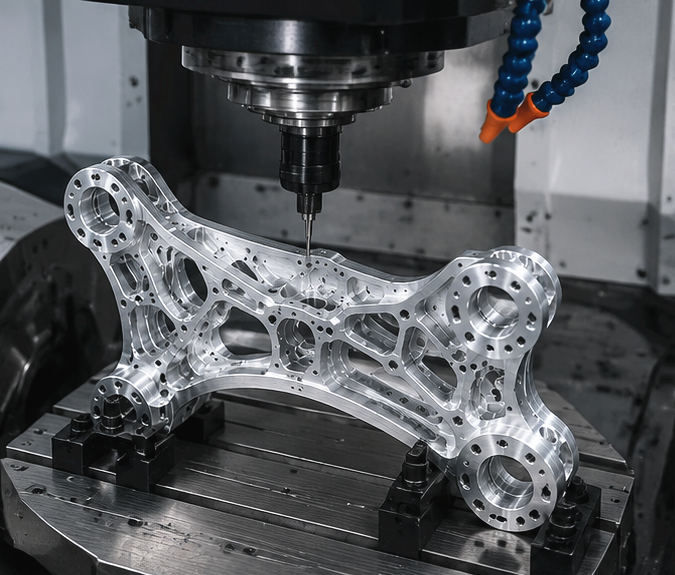
Consider the aerospace bracket shown below.

A raw aluminum billet may weigh several kilograms, while the final component retains only a small percentage of the original material. In some cases, more than 80% of the material must be removed while maintaining dimensional stability and structural integrity.
This is where the difference between a standard machine shop and an experienced precision milling supplier becomes evident.
Why Aluminum Parts Are Often More Challenging Than They Appear
Aluminum is generally considered easy to machine. However, complex aluminum parts introduce challenges that are often underestimated during the design stage.
One common issue is deformation.
As material is removed from a billet, internal stresses within the material are released. Large pocketing operations can cause the part to move, bend, or twist slightly during machining.
Another challenge is vibration.
Long-reach cutting tools used to machine deep cavities can introduce chatter marks, poor surface finish, and dimensional inconsistencies.
Surface finish requirements can also increase complexity significantly. For example, achieving a decorative anodized appearance often requires a completely different machining strategy compared with parts that will remain hidden inside an assembly.
For this reason, experienced manufacturers frequently participate in Design for Manufacturing (DFM) discussions before production begins.
A small design modification can often improve manufacturability while reducing cost and lead time.
Key Capabilities Buyers Should Look For
When evaluating a CNC machining supplier for complex aluminum components, there are several capabilities worth examining.
Advanced CNC Milling Equipment
Three-axis machines are sufficient for many simple parts.
However, components with complex geometries often benefit from 4-axis or 5-axis machining.
By reducing the number of setups, 5-axis machining can improve:
Positional accuracy
Surface quality
Lead time
Consistency between batches
It can also enable features that are impossible or extremely inefficient to produce using conventional machining methods.
Experience With Aerospace-Grade Aluminum
Not all aluminum alloys behave the same way.
For example:
| Alloy | Typical Application | Machinability | Strength |
|---|---|---|---|
| 6061-T6 | General engineering | Excellent | Medium |
| 7075-T6 | Aerospace structures | Good | Very High |
| 2024 | Aerospace components | Moderate | High |
A supplier experienced with aerospace-grade materials understands how machining parameters, fixturing methods, and stress relief strategies affect final part quality.
Inspection Capability
Complex geometry requires reliable verification.
Look for suppliers equipped with:
CMM inspection
Height gauges
Optical measurement systems
Surface roughness testers
Without adequate inspection capability, maintaining tight tolerances becomes difficult regardless of machine quality.

A Real Manufacturing Example
Recently, a customer approached us with a structural aluminum bracket used in a lightweight aerospace assembly.
The component was machined from 7075-T6 aluminum and required:
Significant material removal
Multiple machined faces
Tight positional tolerances
High cosmetic surface quality after anodizing
The primary challenge was maintaining dimensional stability while removing approximately 85% of the original material.
Instead of performing all roughing operations in a single stage, the machining process was divided into multiple controlled operations. Intermediate stress release strategies were incorporated to minimize distortion before final finishing passes.
The result was a stable component that met dimensional requirements while maintaining the lightweight characteristics required by the application.
How to Evaluate a Supplier for Complex Aluminum CNC Parts
When choosing a supplier, buyers should look beyond price. Key evaluation factors include:
Machining Capabilities:
Access to 3/4/5-axis CNC machines
Ability to handle deep cavities, thin ribs, and multi-sided features
Minimum feature size and wall thickness capability
Material Expertise:
Experience with aerospace-grade aluminum alloys like 7075-T6
Knowledge of material behavior during high material removal
Inspection and Quality Control:
Availability of CMM inspection for tight tolerances
Capability to provide full-process quality reports, including FAI if required
Surface finish verification tools
Lead Time & Production Flexibility:
Ability to handle prototypes, small batches, and large production
Flexibility for design changes or rush orders
Technical Support & Communication:
Willingness to participate in DFM discussions
Ability to provide practical feedback to improve manufacturability
Why China Remains a Competitive Choice
China has become a global hub for precision CNC machining because:
Advanced Manufacturing Ecosystem: Access to a large number of suppliers and machining capabilities
Skilled Workforce: Engineers and machinists experienced in aerospace, medical, and robotics applications
Rapid Prototyping Expertise: Quick turnaround on prototypes with high precision
Cost Efficiency: Competitive pricing while maintaining quality, especially for complex aluminum parts
European and American buyers often find that Chinese suppliers can combine speed, precision, and flexibility better than local alternatives for certain complex components.
Brightstar's Manufacturing Capabilities
At Brightstar Prototype CNC Co., Ltd., we specialize in:
Materials: 7075-T6, 6061-T6 aluminum, stainless steel, and engineering plastics
Machining: 70+ CNC machines including 3, 4, and 5-axis mills
Tolerance: Up to ±0.005 mm
Inspection: Zeiss CMM, full-process QC, FAI reports
Applications: Aerospace brackets, medical housings, robotics structural components, automation assemblies
Rapid Prototyping: Turnaround in 3-5 days for prototypes
We focus on parts where precision, complexity, and tight tolerances are critical. For example, our recent aerospace bracket project required removing 85% of the material while maintaining dimensional stability—a task that few suppliers can execute reliably.
Frequently Asked Questions
What is considered a complex aluminum CNC part?
Parts with deep cavities, thin ribs, multi-sided features, tight tolerances, or high material removal rates are generally considered complex.
Can 7075 aluminum be machined accurately?
Yes. With proper machining strategies and inspection controls, 7075 aluminum can achieve extremely high precision.
Is 5-axis machining always necessary?
No. However, complex geometries often benefit from 5-axis machining because it reduces setups and improves accuracy.
What tolerance can be achieved for precision aluminum parts?
Many precision suppliers can achieve ±0.01 mm. For critical features, tolerances up to ±0.005 mm may be achievable.
How can buyers reduce machining costs?
Early DFM review, optimized tolerances, and improved feature accessibility often reduce manufacturing cost significantly.
Final Thoughts
Finding a supplier for complex aluminum CNC parts is not simply about machine availability or low pricing.
Successful projects depend on a combination of:
Engineering expertise
Machining capability
Inspection systems
Manufacturing experience
For industries such as aerospace, medical devices, robotics, and automation, selecting a supplier capable of consistently producing complex aluminum components can significantly reduce project risk while improving quality and delivery performance.
If you are developing a complex aluminum component and would like a manufacturability review, feel free to send your drawings to Brightstar. Our engineering team will be happy to evaluate the project and provide practical manufacturing recommendations.

Disclaimer
The information provided in this article is for general engineering reference only. Actual machining methods, tolerances, and manufacturing strategies may vary depending on part geometry, material condition, and application requirements. Please consult with a qualified manufacturing engineer for project-specific recommendations.